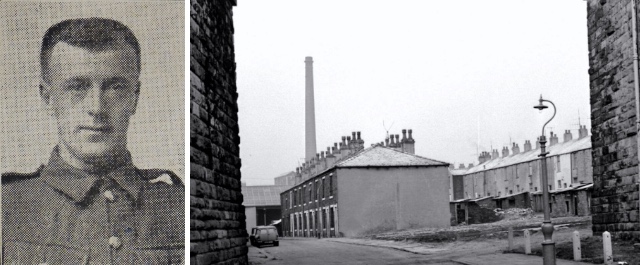
Three awards of the Distinguished Conduct Medal (D.C.M.) were made to Accrington Pals for conspicuous courage during the fateful attack on Serre of 1st July 1916. Two of those awards, to Sergeant Harold Kay and Private William Warburton, were made for the same action, a charge on a machine-gun post in the German front line trench.
Above left: William Warburton. Photograph from the Accrington Observer & Times of 5th September 1916. Above right: Croft Street (now demolished) in Accrington. Photograph from the Garth Dawson Collection (GD77319) by kind courtesy of Judith Murphy. William Warburton was born on 8th November 1884 at 3 Chapel Street in Oswaldtwistle, the son of James Warburton, a cotton weaver, and Alice Warburton (née Nixon or Owen(s)1). Within seven years, James and his father had moved to 12 Croft Street in Accrington where they were living with his grandmother, Rose Warburton. The small family unit was still together in 1901, at 27 Grange Lane in Accrington, by which time William was employed as a drawer in a coal pit. William was still working as a collier when he enlisted into the King's Own (Royal Lancaster Regt.) at Accrington on 9th February 1905; he was described as being 5ft 4½in (1.64m) tall, 127lbs (58kg) in weight, with a 35in (89cm) chest, fresh complexion, grey eyes and brown hair. His time with the regiment was short, for just 27 days after being posted to the regiment's Depot company at Lancaster with the number 8522, he was discharged on 3rd March 'as not likely to become an efficient soldier', a phrase which was not necessarily a reflection of his attitude but might simply have been explained by a lack of teeth (a common condition of the time). On 29th December 1906, William married 16-year-old Caroline Huby at Christ Church, Accrington. Their first daughter, Edith, was born on 9th May 1907; a second daughter, Caroline, followed on 23rd July 1909. By the time of the 1911 Census, William was employed as an iron driller at Howard & Bullough's works in Accrington, and the family of four was living at 18 Victoria Street, Church. At some point in the next three years, William sought better employment in America but, on the outbreak of war, returned home2 to enlist in the Accrington Pals on Christmas Eve 1914, and was assigned the number 17922.
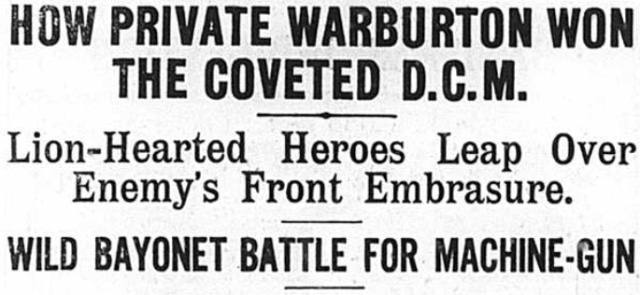
In the attack on Serre of 1st July 1916, William was among a party of men led by Sergeant Harold Kay to rush a machine gun - probably the gun commanded by Unteroffizier Kaiser - in the German front line. It was an action for which both Harold and William were awarded the Distinguished Conduct Medal (D.C.M.). While recovering in Stobhill Military Hospital, Glasgow from a wound sustained on 8th August, William told of the action in an interview that was published in the Yorkshire Weekly Record of 9th September3: We found ourselves - I won't say where nor when - in a most extraordinary position. A good number of us there were, and we were pretty far ahead - near the barbed-wire outside the German lines, as a matter of fact - waiting there for reinforcements to help us push forward. The guns on both sides were pouring out a fearful barrage, our lot keeping the Germans back and their lot keeping ours back. The noisy horror of it all and the feeling of tense anxiety while waiting for reserves to come along were almost unbearable, but they were as nothing to the annoyance and irritation caused by one solitary machine-gun which kept up its vicious spray right in front of us. That gun was a nightmare instrument. It stood at the rear of the German trench before which we lay. It was beautifully protected on all sides, and the only portion of it which we could see was its ugly little nozzle as it darted out and in, in and out, of the tiny, yet ample embrasure which had been made for it. A devilish weapon and devilishly well handled, as we were learning to our cost. The D.C.M. was presented to William by the former mayor of Accrington, Captain John Harwood, in the Council Chamber of Accrington Town Hall on 9th November.4 By this time, William was convalescing from the wounds to his legs at Ellerslie Military Hospital on East Park Road in Blackburn. His recovery was hardly helped when, in the afternoon of Tuesday, 6th March 1917, having attended a matinee performance at one of the picture palaces in Blackburn, he slipped and fell, fracturing his left leg.5 William was discharged from the Army on account of his wounds on 1st November 1917, and returned to employment at Howard and Bullough's works. He would later work as a postman. William and his family were living at Park Farm Cottage in Church in 1921, but shortly afterwards made their home at 219 Stanley Street, Accrington; it would remain William's home address for the remainder of his life. Caroline sadly died of tuberculosis at the age of only 39 on 7th September 1928. Five days after his 69th birthday, William died of bilateral pneumonia, an abscess of the left lung and bronchiectasis at Accrington Victoria Hospital on 13th November 1953. Neither of William's daughters married; they went on to share a home in Lark Hill, Ripon until their deaths, Edith on 10th December 1986 and Caroline on 30th September 1993.
© Andrew C Jackson 2026
|