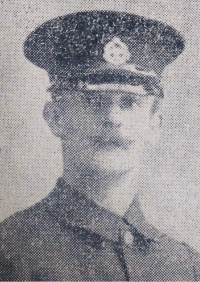
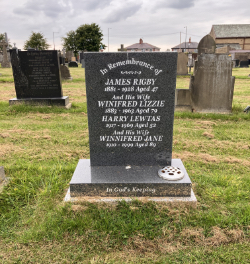
James Rigby was born on 26th March 1885 at 29 Harrison Street, Atherton. He was the third son born to Thomas Rigby, a coal miner, and his wife Jane (née Leicester). The family seems to have moved home frequently; at the age of 16, James had a home address of 127 Boundary Street, Southport when he enlisted into the 3/4th (Militia) Battalion of The King's (Liverpool Regiment) on 17th January 1902. In doing so, he falsely stated his age to be 17 years and 9 months. He was described as being 5ft 2in tall, 109lbs in weight, with a 31in chest, fresh complexion, grey eyes, light brown hair and a scar on the left cheek. James served as a private (6091) for only 49 days before being discharged1. James' career took a very different direction later in the year when he joined the Royal Navy as a Boy 2nd Class on 26th November 1902. Posted initially to the boys' training establishment HMS Boscawen at Portland, he was made up to Boy 1st Class on 27th August 1903 and posted to the training ship HMS Minotaur three weeks later. After six months on the Minotaur, James graduated to Ordinary Seaman (223459) on 25th March 1904. By this time, his height had reached 5ft 3¼in and several additional distinguishing features were noted on his service record: a scar on the forehead, three scars on the back of the head, tattoos of an anchor on the right forearm and five dots on the left forearm, and a long mark on the right wrist.
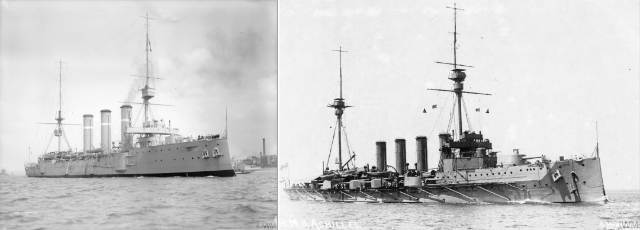
Above left: HMS Cumberland, IWM (Q 21133); above right: HMS Achilles, ©The rights holder (Q 75290). Following a short spell at HMS Pembroke, the shore barracks at Chatham, Rigby was posted to the cruiser HMS Endymion. After a little over six months on the books of the Endymion, he was transferred on 27th July 1906 to the newly-completed cruiser HMS Cumberland on which he would serve for two years until 31st December 1906. During this time, it appears that he went absent without leave for which he received fifty-six days imprisonment with hard labour; the circumstances are not known and before leaving the Cumberland he had been promoted to Able Seaman on 15th December 1906. Rigby went on to serve on the cruisers HMS Leander (2nd March 1907 to 22nd May 1907) and HMS Achilles (13th August 1907 to 6th April 1908) before being discharged "Services No Longer Required" on 16th April 1908 after serving a sentence of ninety days hard labour "for refusing to coal ship"2. Once more in civilian life and working as a labourer, Rigby married 23-year-old Winifred Lizzie Halliwell on 9th January 1909 at St. Paul's Church, Southport. Two years later, the couple were living at 19 Broome Road, Birkdale, Southport with their one-year-old daughter, Winnifred Jane. A second daughter, Gladys May, followed in 1913 by which time the family had moved to Church near Accrington where Rigby was at first employed as a labourer at a sewage works before finding work as a moulder at Howard and Bullough's engineering works.
At some point in the next fifteen months, however, Rigby seems to have lost two stripes, for he was a lance corporal when his bravery in action shortly after the battalion went into the trenches opposite the village of Serre earned an award of the Military Medal. Speaking to an Observer reporter in November 1918, Rigby told of how, in May 1916, he been asked by his company commander, Captain Andrew Watson, to reconnoitre a disused trench in No Man's Land from where three snipers had been doing much damage. After lying out in No Man's Land for three and three-quarter hours, Rigby reported back to Watson and agreed to try to "shift" the snipers. Taking four grenades with him, he went out on his own to the position he had occupied previously and threw three of the grenades into the trench; from what was found in the trench on the following night, it was concluded that the snipers had been killed3. On 1st July 1916, the opening day of the Battle of the Somme, Rigby, now ranked corporal, was in the first wave of the battalion's fateful attack on Serre. Wounded while breaking into the German front-line trench, he made his way back across No Man's Land to report to the battalion's commanding officer, Lieutenant Colonel Arthur Rickman, that only seven of his platoon has made it into the front line; they had held it for about twenty minutes until their supply of grenades was exhausted4. Rigby was wounded on four occasions during the war: hit in eight places on 1st July 1916, he was wounded during the German Spring Offensive of March 1918, suffered a bullet wound in the knee on a third occasion, and a shrapnel wound to the head at Ploegsteert Wood on 28th September 19185. He was discharged as a sergeant on 27th March 1919, and was to receive a pension for 20% disablement owing to his head wound6.
© Andrew C Jackson 2025
|