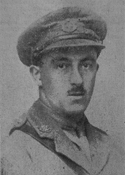
During the first decade of the twentieth century, Tom's father's career took a remarkable change as he founded J. M. Rawcliffe & Co. Ltd., cotton cloth manufacturers at Prospect Mill, Clayton-le-Moors; both of the eldest sons would become involved with the business. By the time the mayor of Accrington, Captain John Harwood, set about raising an Accrington Pals battalion in September 1914, Tom's younger brother Jimmy was already a second lieutenant with the 5th (Territorial) Battalion of the East Lancashire Regiment2; their father phoned Harwood to ask if Tom could join the Pals as an officer. Tom's name was duly one of twelve put forward by Harwood in the third week of September for a first commission. The nomination was accepted with Tom's appointment to a commission and to the rank of second lieutenant being gazetted on 27th October and dated to 17th September. Promotion to lieutenant was dated 20th June 1915. While the battalion was at Hurdcott Camp in Wiltshire in October 1915, Tom married Margaret Ramsbottom, the younger sister of a fellow officer, James Ramsbottom, at St. Mary Magdalen's Church, Accrington. For the Battle for Serre on the opening day of the Somme Offensive, Tom went into action with 94th Brigade Light Trench Mortar Battery (94th LTMB) in Rob Roy Trench. He was to be awarded the Military Cross, the citation for which read: "For conspicuous gallantry and devotion to duty in bringing four trench mortars into position through a very heavy barrage. By determination and coolness he got his guns into position." On 7th December 1916, whilst commanding 94th LTMB, he was promoted to the rank of a/captain. Eleven months later, he was posted to the United States as an instructor to the U.S. Army. Once back in civilian life, Tom took up employment as a cotton cloth agent with McElin Bullock & Co. Ltd. of Manchester. In June 1921, he and Margaret were living at Clayton-le-Moors with their two children, Peter Welburn3 and Nancie. Tom later ran a market garden in the grounds of Lytham Hall before moving with his family to Sheffield where he managed a greyhound track. Tom re-enlisted in 1939 and helped to defend RAF stations Finningley and Scampton. He and Margaret moved to Retford in 1942 when Tom was appointed adjutant to the town's Home Guard. Known as a "local character", he was landlord at the Blue Bell Inn, Lound for about ten years.4 For the 1st July 1966 edition of the Lancashire Evening Telegraph Tom wrote the following article, which appears here thanks to Newsquest Media Group/Lancashire Telegraph and Tom's grandson, Peter Kirmond.
"Of all the battalions that were decimated on the Somme on July 1, 1916, none had a higher esprit-de-corps than the 11th Battalion, The East Lancashire Regiment or, as it was commonly called, the Accrington Pals Battalion. Though the majority of the officers and men were from Accrington and adjoining districts there were detachments from Blackburn and Chorley and about a company from Burnley. If the rank and file had not had the highest esprit-de-corps the battalion would have been merely a mob, and not the highly efficient and disciplined unit it was, because its training for the first six months of its existence was of the most amateurish nature. Few of the officers had any military training or experience before being commissioned and the first NCOs were chosen in a most haphazard way. Any soldier who had Regular Army experience or even Territorial or Volunteer service was given NCO's rank. In the early months of training only the wish and will to become efficient soldiers could have overcome the blatant lack of military knowledge of the officers and NCOs. A song of that time "We are Fred Karno's army, what ruddy use are we?" was fully applicable to the Pals in those early days. Looking back 50 years it now seems a miracle that in just over a year the Pals became such a well-disciplined and fully-trained unit as they proved themselves to be on the attack on the village of Serre on July 1, 1916." "Many stories, both grave and gay, could be told of the early days of training. Here are a few that come to mind and bring back nostalgic memories of happy times and gallant comrades-in-arms." "The first battalion headquarters was in a vacant butcher's shop at the commencement of Whalley Road, Accrington, not far from Avenue Parade where the first CO, Lt. Col. Dick Sharples had his solicitor's office. Major George Slinger, another Accrington solicitor, was adjutant and second-in-command, and his office at H.Q. was in a lower storey than that of the CO. Every morning at about 11 a.m. the Colonel would shout down the stairs to the adjutant: "George I'm just going across to the office," and off he would go to attend to his business, whereupon George would shout to Teddy Jones in the orderly room and say he was just going out for a few minutes. Then he would toddle down to the Commercial Hotel for a 'sneck-lifter'. Both would be back on duty when the morning parades were over." "Colonel Sharples rarely appeared on training parades and so to keep in touch with the officers and men he instituted a series of lectures at the Argyll Street drill hall given by each officer in turn one night per week. Many of these lectures could have caused a riot but for the willingness of the men to stand for anything as long as they became efficient members of H.M. Forces. After each lecture the men were invited to ask questions which were generally answered by Col. Sharples or Major Slinger, who used to stand on the platform and frequently have friendly (and amusing) arguments as to correct answers to the questions. This earned them the soubriquet of 'Mick and Mack the cross talk comedians'." "On one occasion Captain Peltzer, who had been on a musketry course and was lecturing on that subject, was asked by a Private O'Reilly what was the length of a service rifle. Peltzer told him. Then O'Reilly, in a truly Irish brogue, asked "What's the length of a rifle with the bayonet on it," to which Peltzer somewhat airily replied: "Oh about a foot longer." "No, sir, it's the same length," blurted out O'Reilly, to the laughter and applause of all present - except Captain Peltzer." "Another lecture, this time a lantern lecture by Captain Roberts, who was in charge of the Blackburn contingent, was on Belgium and the towns that had been devastated by the Germans. Somehow, hardly accidentally, the slides got mixed so when Roberts announced that the next view was of ravaged Liege, and changed the slide, a view of the port of Antwerp appeared on the screen to everyone's amusement and cheers. So it went on throughout the lecture." "Another idea of the Colonel's was to have long route marches on Saturday afternoons and many hours were spent tramping over the moors between Haslingden and Church. Many of the Blackburn men used to disappear as the battalion marched back to Accrington and completed their march nearer their homes in Blackburn." "The most notable route march, however, was the night march from Accrington to Burnley and back. The battalion paraded in Avenue Parade sometime after 10.0 p.m. when it was obvious that many of the men had visited the 'locals' before appearing on parade. The march got off to a good start but before reaching Huncoat a whispered order to form 'two deep' and then 'single file' was passed down from the CO in front. In consequence the battalion strung out with the result that when the order to form fours was received the men at the rear of the column had to do the 'double' to catch up with the leading platoons. This occurred more than once on the march. Then an order was passed from the second-in-command at the rear of the column: "Halt in front." The order never reached the officer in charge of the second platoon of the column and so two platoons, led by the CO and and a private carrying a storm lantern, went marching on to Burnley, much to the annoyance and disgust of the second-in-command, George Slinger, when he arrived at the head of the halted troops. Burnley detachment provided a lot of refreshments at their drill hall, both liquid and solid, and some of the marchers had to return to Accrington in taxis too unsteady to march. The liquid refreshments urged the men to sing on the return journey and it was surprising what bawdy marching songs they knew - some of them so bawdy that there were complaints about the language from some of the citizens of Accrington. There were no more night marches to Burnley or anywhere else." "One of the amusing and astounding episodes of the period of training in Accrington was the occasion when news of promotion for some of the officers came through. The junior officers lunched at the local hotel where the promotions were duly wetted, rather liberally with the result that the officers appeared late for the afternoon parade on 'The Tenement' to find no troops there, merely a large empty space. The resulting sight of young officers asking civilian passers-by if they had seen any soldiers about was worthy of Punch." "The stand-by of the officers who learned their drill as they tried to instruct the men was a small manual by Gale and Polden. To see the officers with the book in their hand while drilling the men was a most incongruous sight, as was the CO - ably aided by the second in command - drilling the battalion on the Coppice wearing a civilian cap as the wind persisted in blowing off his service cap. The battalion got into some real tangles after the complicated movements ordered by the two leading officers, but it was always possible to return to normality by 'falling out' the battalion for ten minutes rest and then forming up again on markers in column of platoons. The CO, affectionately known as 'Old Dick', would call out to the second-in-command, Major George Slinger: "What shall we do next George?" And so the training went on. This phrase became quite a catch word in the battalion." "As time passed most of the officers specialised in some form of training and Captain Harry Cheney specialised in map reading and the like. One evening he was to give a lecture to all officers in the Drill Hall, Chorley, on 'How to Find Your Way in the Dark', and all the officers duly turned up and awaited the lecturer. Unfortunately, he lost his way between Accrington and Chorley and the lecture started very late." "Then there was the occasion when Colonel Rickman noticed that two of his junior officers had shaved off their moustaches, which he'd insisted all officers should cultivate. Mentioning them by name, he said: "I see you've shaved off your moustaches. Get them on - get off parade." Off they went and did not appear again until they could show enough growth on the upper lip to meet the CO's requirements." "These are a few of the memories of a battalion of men, all volunteers, who, in spite of all kinds of temptations to take advantage of the officers and NCOs, blended themselves into a truly well-disciplined and efficient fighting unit. They went over the top on the Somme on Saturday, July 1, 1916, to almost total destruction." Margaret passed away in 1965, Tom surviving her by almost twenty years; he died at Retford on 11th October 1984 at the age of 91.
© Andrew C Jackson 2026
|