As part of the research that went into One Day at Passchendaele I made use of CWGC Concentration Reports to extend the battle narrative beyond that provided by division, brigade and battalion war diaries. The map coordinates provided by the Reports revealed the locations from where the remains of officers and men of the 49th and 66th Divisions had been recovered postwar and gave a fresh insight into the efforts made by them, and their comrades, to reach their objectives.
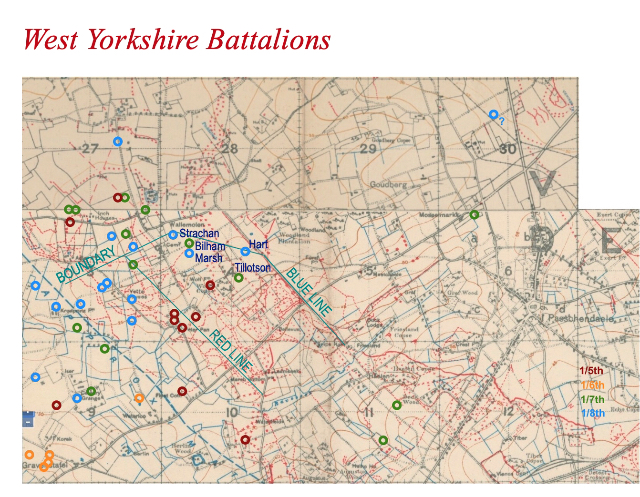
As space could not be found in the book for the detailed maps generated from the coordinates, they appear here. The base map, a 1:20,000 scale trench map of the Passchendaele area dated October 1917, is reproduced with the permission of the National Library of Scotland. The first map plots the locations from where the remains of men of the West Yorkshire battalions of 146 Brigade were recovered. (Refer to book pages 80-1.) Also shown is the left boundary of the brigade, and the first and second objectives of the brigade (Red Line and Blue Line). Although the line reached by 1/8th West Yorkshire fell short of the Red Line, the data suggests that some men from the battalion pushed on, even as far as the Blue Line - as did some from the adjoining 1/7th battalion. The data would also indicate that some men strayed north, beyond the brigade boundary.
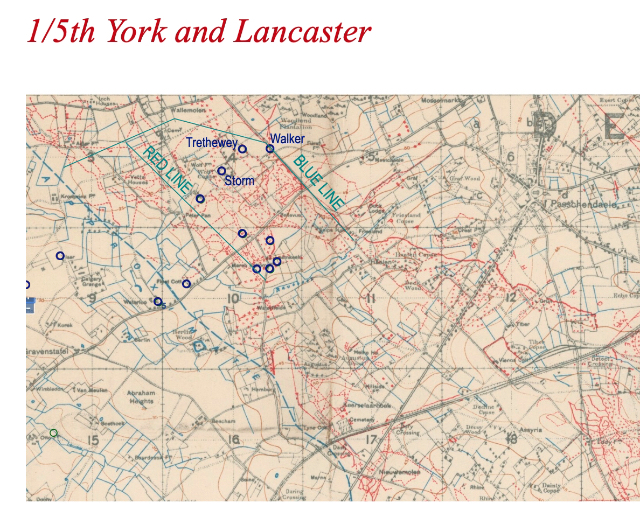
The second map shows the locations from where the remains of men of 1/5th York & Lancaster were recovered - mostly in a semicircle around the crest of the Bellevue spur. (Refer to book page 97.) Again it might be inferred that some men got as far as the Blue Line. The remains of Captain William George Storm MC were recovered from the area of Wolf Copse.
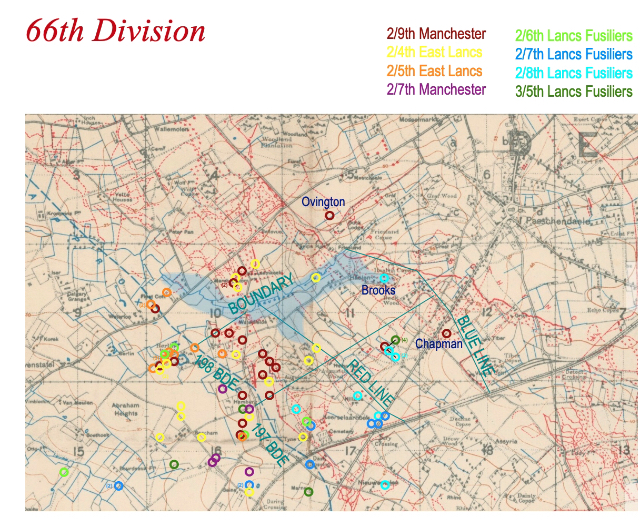
The third map shows the locations from where the remains of men of 198 and 197 Brigades (66th Division) were recovered. Particularly striking is the large number clustered within 300 yards of the jumping-off line of 198 Brigade - hardly surprising considering the impassable, waterlogged ground that lay in front of the brigade. War diaries indicate that men of 66th Division made use of the one remaining bridge over the Ravebeek to move over to the left bank and this is supported by the remains of men of 2/4th East Lancashire and 2/9th Manchester being found in the area of Marsh Bottom and Laamkeek. (Refer to book page 113.)
© Andrew C Jackson 2026 |